
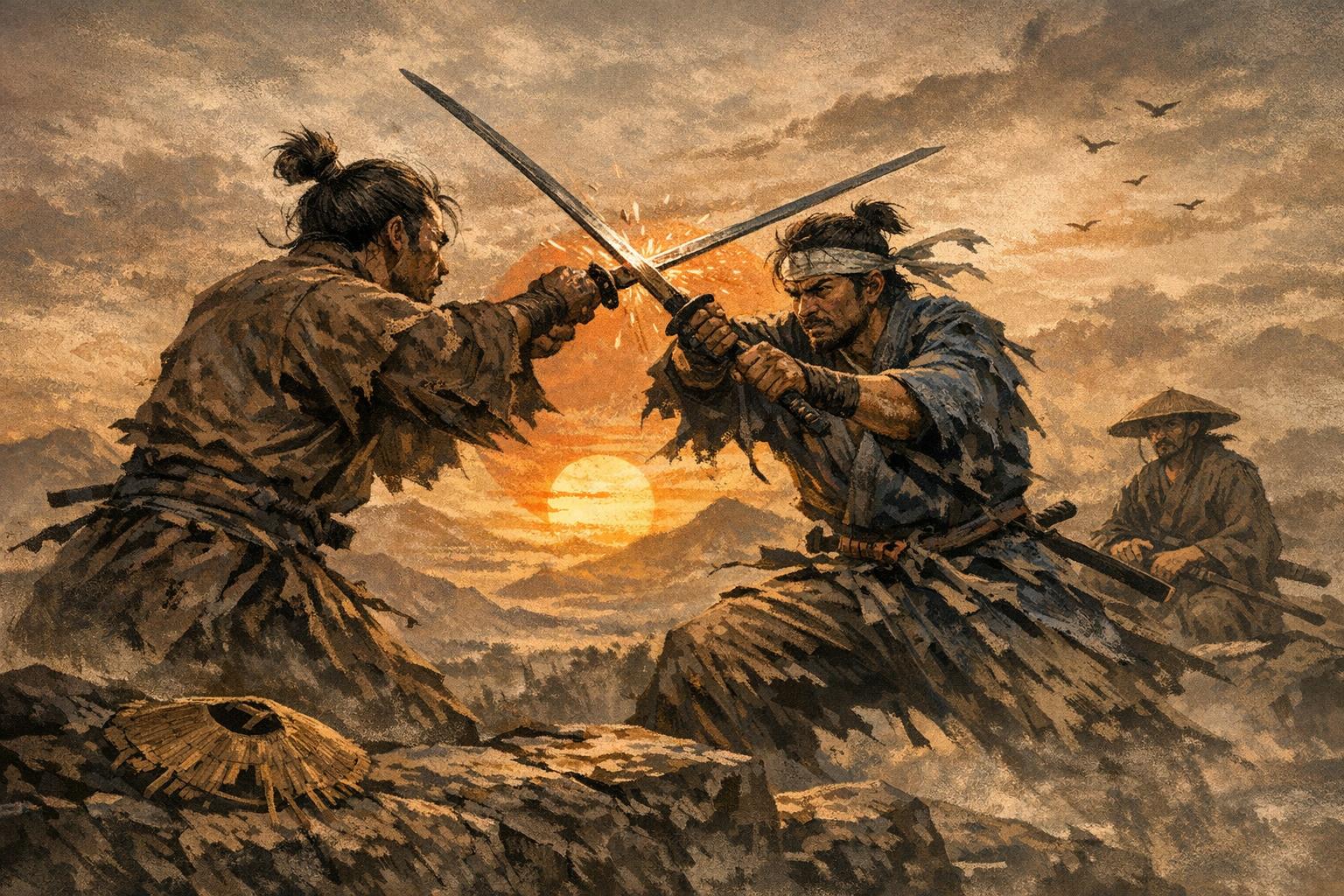
The Rise of Ronin as Notable Duelists
In feudal Japan, the samurai class was defined by military service, hereditary status, and adherence to the ethical framework known as bushido. While the ideal samurai served a daimyo with loyalty and discipline, political instability and prolonged warfare created conditions in which many warriors found themselves without masters. These masterless samurai, called ronin, developed a distinct presence within Japanese society. Among the various paths available to them, dueling emerged as one of the most visible and consequential arenas in which ronin demonstrated their skill. Over time, the figure of the ronin duelist became embedded in historical record and later cultural memory as a symbol of technical refinement, independence, and martial adaptability.
The Social Status of Ronin
Ronin occupied an ambiguous position within the rigid class hierarchy of feudal Japan. Formally, they remained members of the warrior class. They retained the right to bear swords and were trained in martial disciplines that distinguished them from peasants, artisans, and merchants. However, without a lord to serve, they stood outside the central framework that justified samurai privilege. Service was not merely employment; it was the foundation of samurai identity. A samurai’s stipend, residence, and social network were typically tied to domain administration and military obligation. When that connection disappeared, so too did economic security and social clarity.
This absence of patronage led to a range of outcomes. Some ronin sought immediate employment with a new daimyo, offering their experience in exchange for stipends or administrative positions. Others became instructors in swordsmanship, archery, or military strategy, founding or joining martial schools that formalized techniques into structured curricula. A smaller number entered into mercenary arrangements or served as retainers on a temporary basis.
Despite these opportunities, suspicion often surrounded ronin. Without stable affiliation, they were perceived as unpredictable. Authorities worried that unemployed warriors might engage in disorderly behavior or participate in uprisings. As peace gradually emerged during the Tokugawa period, the ideological role of the warrior class shifted from battlefield service to bureaucratic governance. In that environment, the ronin, especially those trained primarily for combat, faced increased marginalization. Dueling provided a controlled and recognized method for demonstrating legitimacy within a society that increasingly lacked open warfare.
Historical Context and Skills
The proliferation of ronin was closely linked to the turbulence of the Sengoku period, which spanned roughly from the mid-fifteenth to the early seventeenth century. During this era of sustained civil conflict, alliances shifted frequently. Daimyo lost territories, were defeated in battle, or were compelled to submit to stronger rivals. When a domain collapsed, retainers could be killed, absorbed by the victor, or left without employment. Large-scale campaigns generated a surplus of trained fighters whose loyalty had been rendered obsolete by changing political boundaries.
The eventual unification of Japan under Tokugawa Ieyasu in the early seventeenth century further altered the military landscape. Major wars diminished, and the new regime instituted a centralized system that restricted private armies and reinforced hierarchical control. While many samurai transitioned into administrative roles within castle towns, not all found positions within the new order. Some domains were reduced in size, and stipends were cut. As a result, additional warriors became ronin, not through battlefield defeat but through fiscal and political restructuring.
Training among samurai had long emphasized weapon proficiency, horsemanship, and tactical awareness. Swordsmanship in particular developed into highly refined systems. Different schools, or ryu, formalized techniques involving timing, distancing, posture, and psychological awareness. These schools preserved battlefield methods while adapting them to one-on-one encounters. For ronin, mastery of such systems was often their primary resource. Without land or stipend, their expertise in combat became a form of capital that could be demonstrated publicly.
Dueling served as a practical demonstration of these abilities. Challenges could be issued between practitioners of rival schools to test technical claims. A victory brought prestige not only to the individual but also to the system they represented. In some cases, duels were arranged to settle disputes or clarify reputations. In others, itinerant ronin traveled from region to region seeking matches that would enhance their standing. The ability to defeat an established instructor or respected retainer could result in invitations to teach or to serve under a new lord.
The Appeal and Philosophy of Dueling
Within the intellectual framework of the warrior class, dueling was not conceived primarily as entertainment. It functioned as a method of establishing relative skill within a society that valued hierarchy and measured performance. A duel often followed protocols designed to ensure fairness and clarity of outcome. Witnesses might be present, and the weapons used could vary depending on agreement. Wooden practice swords were sometimes employed for training matches, while live blades were reserved for more formal or high-stakes encounters.
The philosophical orientation of many duelists drew upon Zen Buddhist concepts that emphasized presence, awareness, and control over mental distraction. Concentration on the immediate moment, known through terms such as zanshin (remaining mind), was considered essential. The ability to act without hesitation required training that integrated body and mind. For ronin who lacked social grounding in a stable household, disciplined practice offered continuity. Daily training, meditation, and teaching reinforced a structured routine even in the absence of permanent employment.
At the same time, dueling allowed ronin to reframe their marginal position. Rather than appearing as displaced retainers, successful duelists presented themselves as autonomous masters of technique. Adaptability became a defining attribute. Unlike retainers who trained within a single domain’s preferred style, itinerant ronin often encountered multiple schools. Exposure to diverse methods encouraged experimentation and refinement. Over time, this cross-pollination contributed to technical innovation in swordsmanship.
It is important to note that official authorities did not always encourage duels. Particularly during the stable Tokugawa years, public violence threatened the order the shogunate sought to maintain. Certain duels were prohibited or carefully regulated. However, informal challenge matches persisted, especially within martial communities. As open warfare declined, the duel emerged as one of the few remaining mechanisms through which martial excellence could be visibly tested.
Famous Ronin Duelists
Among the ronin who achieved lasting recognition, Miyamoto Musashi stands as the most frequently cited example. Active in the late sixteenth and early seventeenth centuries, Musashi reportedly participated in more than sixty duels, claiming victory in each. While historical verification of every account remains complex, contemporary records confirm that he engaged in multiple documented matches against skilled opponents. Musashi developed a distinctive approach sometimes described as the Niten Ichi-ryu, characterized by the simultaneous use of two swords. This method contrasted with the more conventional single-blade emphasis of many schools.
Musashi’s written work, commonly known as The Book of Five Rings, articulated principles concerning timing, rhythm, perception, and strategy. Although composed later in his life, the text reflects lessons drawn from decades of experience as a fighter and teacher. His career illustrates how a ronin could translate dueling success into instructional authority, attracting students and achieving a measure of stability without permanent feudal attachment.
Another prominent figure associated with ronin dueling culture is Sasaki Kojiro. Renowned for his proficiency with an unusually long sword, Kojiro founded a style that emphasized reach and precision. The widely recounted duel between Kojiro and Musashi in 1612 has become emblematic of the era’s martial contests. According to traditional narratives, the encounter took place on an island after formal arrangements were made. Musashi’s adaptive tactics, including unconventional timing, reportedly contributed to his victory. Whether embellished or not, the episode illustrates how individual duels became focal points for broader debates about technique and philosophy.
Beyond these well-known names, numerous lesser-documented ronin traveled throughout Japan engaging in what was known as musha shugyo, a warrior’s pilgrimage. During such journeys, practitioners sought instruction, observed other schools, and engaged in bouts intended to test their training. While not all encounters were lethal, the cumulative effect of these exchanges fostered a competitive environment in which improvement was continuous. The culture of challenge helped standardize certain practices and elevated reputations based on performance rather than lineage alone.
The Institutionalization of Martial Schools
As Japan entered a prolonged period of peace under Tokugawa rule, the context of dueling shifted. Formal battles receded, but martial training did not disappear. Instead, it became institutionalized within dojo environments. Ronin played a significant role in this transformation. Without administrative duties in a domain, many dedicated themselves fully to technical refinement and pedagogy. They codified kata, structured rank systems, and authored treatises explaining foundational concepts.
In this environment, duels continued but often in modified form. Matches using wooden swords or bamboo practice weapons reduced fatal outcomes while preserving competitive intensity. Excelling in these contests enhanced a school’s credibility and attracted students. A successful ronin instructor could secure patronage indirectly by teaching the retainers of a lord rather than serving as a direct vassal. In this way, dueling achievements translated into economic sustainability.
The disciplined ethos associated with bushido was reinterpreted during this stable era. Loyalty remained central, but moral self-cultivation gained prominence. Ronin who maintained rigorous practice and ethical conduct could reinforce the perception that mastery transcended formal attachment. Their independence, when paired with discipline, was sometimes reframed as evidence of personal integrity rather than instability.
Ronin, Reputation, and Cultural Memory
Over time, the historical ronin duelist became a subject of literature, drama, and later visual media. However, separating verifiable fact from artistic embellishment requires careful attention. Contemporary records confirm that masterless samurai participated in duels and that certain individuals achieved renown through such encounters. At the same time, later retellings often amplified episodes to highlight themes of strategy or moral resolve.
The persistence of these narratives suggests that the ronin duelist fulfilled a conceptual need within Japanese historical imagination. In a society ordered by hierarchy and duty, the masterless warrior represented both disruption and continuity. Through dueling, ronin affirmed the technical and philosophical core of the samurai tradition even when detached from its institutional base. Their careers demonstrated that martial knowledge could survive political transition.
Conclusion
The emergence of ronin as notable duelists was not a sudden development but the result of interconnected social and political processes. Periods of warfare produced displaced warriors, while subsequent peace limited conventional military roles. In response, many masterless samurai turned to dueling as a setting in which to validate skill, secure patronage, and maintain relevance. Their expertise in swordsmanship, combined with intellectual engagement with Zen-influenced discipline and strategic theory, elevated certain individuals to widespread recognition.
Figures such as Miyamoto Musashi and Sasaki Kojiro exemplify how technical innovation and personal adaptability could transform marginal status into enduring influence. Through organized schools, written treatises, and documented encounters, ronin helped shape the evolution of Japanese martial arts during a period of significant transition. Their legacy persists not merely as anecdote but as part of the broader history of how martial traditions adapt to changing political and social realities.