
Introduction
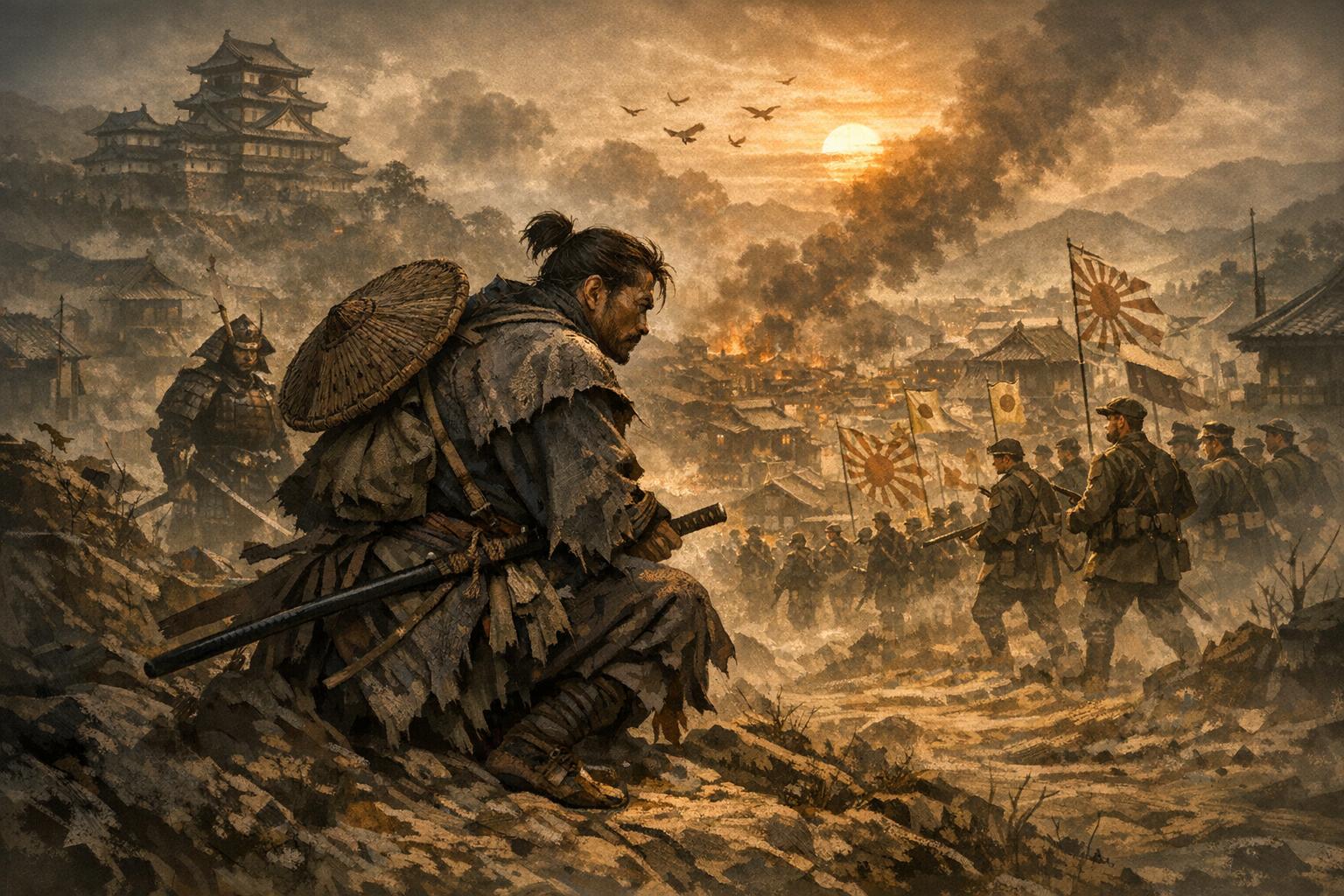
The term ronin refers to a samurai who lost his master and, as a result, his formal place within the feudal hierarchy of Japan. In a society structured around loyalty and service, this status represented a significant social and economic disruption. A samurai’s identity was closely tied to his daimyo, or feudal lord, and the dissolution of that bond—whether through death, political restructuring, or dismissal—left the warrior without income, protection, or defined purpose. The literal meaning of ronin, often translated as “wave man,” evokes the image of a person adrift, moving without fixed direction.
Although ronin existed throughout Japan’s feudal history, their numbers increased significantly during periods of political transition, particularly in the Edo period and the turbulent years leading to the Meiji Restoration. As Japan’s political landscape transformed from a fragmented warring state environment to centralized rule and eventually to a modern nation-state, these masterless warriors faced the challenge of redefining their roles. Their responses to these changes reveal not only the shifting structure of Japanese society but also the flexibility embedded within the samurai tradition itself.
Historical Context
The Sengoku period (1467–1603) was marked by near-constant military conflict among competing daimyos. During this era, skilled warriors were in continuous demand, and loyalty was often fluid. Samurai who lost one lord could frequently find service under another, especially if they had proven ability. The political fragmentation of the country created many opportunities for martial employment.
This dynamic changed dramatically following the unification of Japan under Tokugawa Ieyasu in 1600 and the establishment of the Tokugawa shogunate in 1603. The Edo period (1603–1868) brought more than two centuries of relative peace and strict social order. The Tokugawa regime implemented a rigid class structure that formally separated society into warriors, farmers, artisans, and merchants. Samurai stood at the top of this hierarchy, but the prolonged absence of warfare gradually altered their practical function.
Without frequent military campaigns, many samurai shifted from battlefield roles to administrative duties within their domains. However, not all domains possessed the financial resources to maintain large numbers of retainers. Economic pressures, administrative reforms, and occasional domain collapses resulted in dismissals. When a lord died without an heir or when a domain was abolished, retainers could suddenly find themselves without stipends. As the number of such displaced warriors grew, so too did the population of ronin.
The increasing monetization of the Tokugawa economy added to these pressures. Samurai stipends were generally paid in rice, and fixed stipends could lose value in fluctuating market conditions. Lower-ranking samurai were especially vulnerable, and economic hardship often preceded their transition into ronin status. Thus, the growth of masterless warriors was not solely the result of political upheaval, but also of structural economic change.
Adapting to New Roles
Faced with the loss of official income and status, ronin had to find alternative means of subsistence. While some attempted to secure new patrons, opportunities were limited in a stable and hierarchical society. As a result, adaptation was often necessary.
Many ronin became teachers. Samurai education traditionally included literacy, calligraphy, Confucian ethics, history, and martial training. These skills positioned them to instruct children of both samurai and wealthy commoner families. The expansion of temple schools and domain academies during the Edo period created demand for educators who could teach moral philosophy and basic literacy. In this setting, the intellectual training of the samurai proved valuable. Former warriors could maintain a degree of status by serving as instructors, transmitting ethical frameworks closely connected to bushido, the code associated with samurai conduct.
Others found employment as bodyguards or mercenaries. Although large-scale warfare was rare, the need for personal security did not disappear. Wealthy merchants, traveling officials, and regional authorities sometimes hired skilled swordsmen for protection. These roles were commercial rather than feudal, reflecting the broader shift toward a monetized economy. In such positions, ronin applied their martial expertise in practical contexts, though without the hereditary loyalty that characterized classical samurai service.
Some masterless warriors entered trade or small-scale business. Official ideology discouraged samurai participation in commerce, but economic necessity often outweighed social expectations. A ronin might operate a small shop, engage in money lending, or participate in local industries. Although this represented a departure from the idealized warrior ethos, it illustrated a willingness to function within the economic realities of the time.
Involvement in Local Administration
Administrative service was another avenue for adaptation. The Tokugawa government relied on detailed record-keeping, taxation systems, and legal oversight. Literacy and familiarity with bureaucratic norms made former samurai suitable candidates for clerical and managerial roles. Some ronin were employed by domains that required additional manpower for governance but lacked the resources to sustain large hereditary retinues.
In these positions, ronin applied principles rooted in their military and ethical training. The structured thinking developed through strategic study translated into competencies in planning, dispute resolution, and taxation oversight. Their grounding in Confucian thought, which emphasized hierarchy, duty, and order, aligned with the ideological foundation of Tokugawa rule. Thus, the transition from sword-bearing retainer to civil official did not necessarily require abandonment of core values, but rather reinterpretation.
Participation in local administration also offered a path to restored legitimacy. Although ronin occupied an ambiguous status, steady civil employment could reintegrate them into structured communities. The capacity to serve effectively in non-military roles contributed to social stability during a period of minimal warfare.
Embracing Arts and Literature
Cultural pursuits provided an additional sphere of activity. The Edo period witnessed significant growth in urban culture, including developments in literature, theater, painting, and poetry. Some ronin directed their discipline and education toward artistic production. Their training in calligraphy and classical texts enabled them to compose essays, scholarly commentaries, and poetic works.
Engagement with the arts did not represent a sharp break from samurai tradition. Cultivation of refinement had long been a component of elite warrior culture. Swordsmanship coexisted with appreciation of tea ceremony, ink painting, and linked verse. For ronin, deeper immersion in these cultural practices offered both intellectual engagement and, at times, modest income.
Literary depictions of ronin also contributed to popular culture. Dramas and stories explored themes of loyalty, honor, and personal struggle. The most widely known narrative, involving the Forty-Seven Ronin, portrayed masterless samurai who avenged their lord despite legal prohibitions. While dramatized, such accounts shaped public understanding of duty and sacrifice, reinforcing elements of the warrior ethic even in a peaceful era. The cultural influence of ronin thus extended beyond their individual experiences into broader social imagination.
Involvement in Revolts and Political Movements
Not all ronin adapted quietly. Periods of transition created opportunities for political activism. In the late Edo period, dissatisfaction with the shogunate increased due to economic strain, foreign pressure, and internal criticism. Masterless samurai, unconstrained by direct loyalty to a daimyo, sometimes found space to align with reformist or nationalist movements.
During the 1850s and 1860s, political groups advocating imperial restoration attracted participants from various domains. Some ronin engaged in activities supporting the slogan sonno joi—“revere the emperor, expel the barbarians.” Their military training proved useful in confrontations and covert actions. While not all activism was violent, the skills of former warriors were relevant in a climate of instability.
The Meiji Restoration of 1868 ultimately dismantled the Tokugawa order and restructured Japanese governance around imperial authority and centralized institutions. Various former samurai, including ronin, played roles in the conflicts that weakened the shogunate. Their contributions ranged from direct combat to advisory and organizational work within reformist domains.
Supporting National Movements
In the new Meiji state, formal samurai privileges were gradually abolished. Stipends were commuted, and the wearing of swords in public was prohibited. For ronin, who had already experienced detachment from hereditary service, the transition to a modernized social order could be both challenging and familiar.
Some former ronin entered government service within the emerging national bureaucracy. The modern state required administrators, military officers, police officials, and educators. Individuals with prior training in discipline and literacy could integrate into new institutions. Others participated in movements advocating constitutional governance and industrial development.
At the same time, resistance to modernization occasionally emerged. The Satsuma Rebellion of 1877 involved disaffected former samurai, though not exclusively ronin, who opposed certain reforms. These conflicts highlight the diversity of responses among masterless warriors. Some aligned with modernization efforts, while others favored preservation of traditional status structures.
Conclusion
The history of the ronin reflects the broader transformation of Japanese society from feudal fragmentation to centralized peace and eventually to modern statehood. Initially defined by the loss of a master, ronin occupied a precarious position within a rigid hierarchical framework. However, their experiences demonstrate that status loss did not inevitably result in marginalization.
Through roles in education, administration, security, commerce, and the arts, many ronin maintained relevance within a changing environment. Their intellectual training facilitated entry into civil service and cultural production, while their martial skills found application in both security work and political activism. In moments of upheaval, particularly during the Meiji Restoration, masterless samurai sometimes assumed responsibilities in national transformation.
The figure of the ronin illustrates how individuals shaped by a martial tradition responded to sustained peace, economic monetization, and political restructuring. Rather than representing a uniform class defined solely by displacement, ronin encompassed a range of adaptive paths. Their capacity to reinterpret inherited values within new institutional contexts contributed to continuity amid change. In this way, the evolution of the ronin parallels the evolution of Japan itself during the early modern and early modernizing eras.