
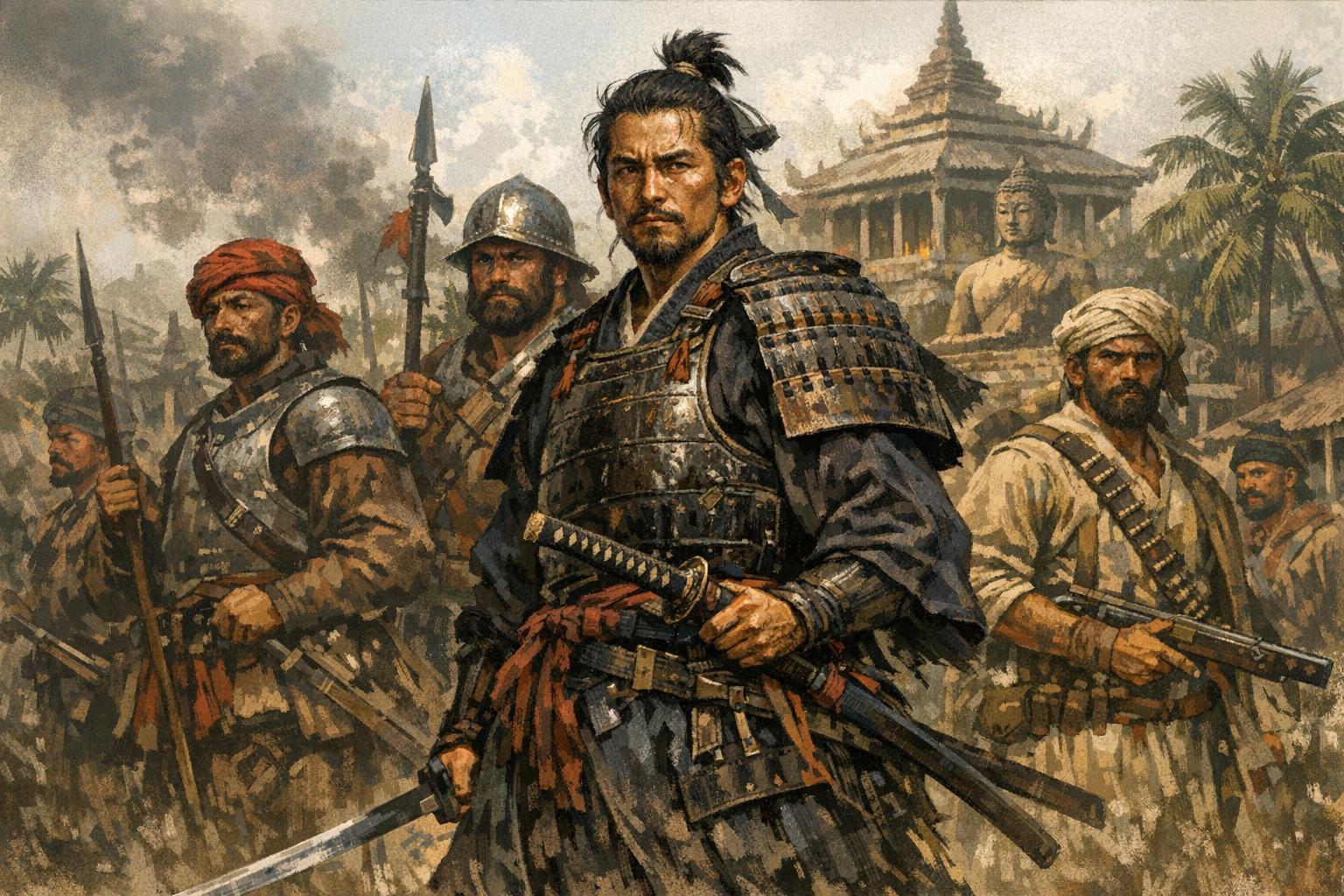
Understanding the Role of Ronins as Hired Mercenaries
The term ronin originally referred to samurai warriors in Japan who had become masterless due to their lord’s death, political dispossession, or loss of patronage. In a feudal system structured around loyalty and hierarchical obligation, the bond between a samurai and his daimyo defined social identity, legal standing, and economic survival. When that bond dissolved, the displaced warrior entered a precarious condition. Over time, some of these skilled fighters adapted to altered socio-political realities by offering their services beyond traditional feudal allegiances, including periods in which they functioned as hired soldiers. In certain historical contexts, this role resembled mercenary activity, whether within Japan or, in limited cases, abroad.
Historical Context of Ronins
The emergence of the ronin as a recognizable social category occurred during Japan’s feudal era, particularly from the Kamakura period (1185–1333) through the Edo period (1603–1868). The samurai class originated as a military elite serving regional warlords. Their privileges included stipends, the right to bear arms, and distinctive social status. However, the political landscape was not static. Shifting alliances, military defeat, confiscation of lands, and administrative reforms frequently left retainers without employment.
The Sengoku period (c. 1467–1603), characterized by prolonged civil war, produced large numbers of displaced warriors. Warfare created opportunity, but it also generated instability. Armies were raised and dismissed with changing fortunes. In such an environment, personal martial ability could be commodified. Samurai who lost their direct patron sometimes sought alternative employers, temporarily or permanently placing their skills at the service of another lord. Although this practice did not always align with idealized notions of hereditary loyalty, it was not uncommon during eras when survival required pragmatic adjustment.
With the establishment of the Tokugawa shogunate in the early seventeenth century, Japan entered a prolonged period of relative peace. Paradoxically, this peace expanded the ranks of the ronin. Administrative consolidation and domain restructuring reduced the need for large standing forces. Samurai stipends were reassessed, and entire retainer bands were dissolved following the defeat or demotion of rival houses. Without war as a consistent outlet and without land-based income, many former retainers found themselves economically vulnerable.
In this context, some ronin sought employment as instructors, guards, or officials. Others turned to activities that more closely resembled mercenary service, participating in local conflicts, policing activities, or private security arrangements. While the classic image of a wandering swordsman is partly literary, the underlying reality was that many masterless samurai had to negotiate a competitive labor market for martial expertise.
Ronins Serving as Mercenaries Abroad
Compared to internal displacement, the movement of ronin into foreign service was limited but historically documented. During the late sixteenth and early seventeenth centuries, Japan experienced increased contact with Southeast Asia through trade networks known as the “Red Seal” system. Japanese merchants and adventurers established communities in ports such as Ayutthaya in Siam (modern Thailand), Hoi An in Vietnam, and Manila in the Philippines. Within these expatriate communities were former samurai, some of whom entered military service under foreign rulers.
In Ayutthaya, for example, Japanese warriors formed a recognized contingent within the royal military structure in the early seventeenth century. They were valued for their discipline, familiarity with firearms, and close-combat proficiency. Contemporary records from both Japanese and Southeast Asian sources note their participation in palace intrigues and regional campaigns. Although their numbers were not large relative to local forces, their presence illustrates how martial professionals could integrate into non-Japanese political systems under contractual or patronage-based arrangements.
These engagements had characteristics commonly associated with mercenary service. The ronin entered agreements based on compensation and conditional loyalty rather than hereditary fealty. Payment could take the form of stipends, trade privileges, or land grants within expatriate settlements. In return, they provided military expertise that augmented local armies, particularly in specialized roles involving matchlock firearms and sword combat techniques developed during Japan’s era of internal warfare.
Their integration was not without tension. Foreign courts had to balance the advantages of employing experienced outsiders against concerns about factionalism and political reliability. In some instances, Japanese military communities became influential power brokers, participating in succession disputes or acting as royal bodyguards. When political tides shifted, these groups were sometimes suppressed or expelled, demonstrating the contingent nature of mercenary allegiance in foreign polities.
Motivations for Becoming Mercenaries
Economic Incentives: Economic necessity was a central factor in the decision of some ronin to seek hired military work. The stipends once guaranteed by hereditary service disappeared when a lord was defeated, died without successor, or reduced his retinue. Unlike peasants tied to agricultural production, samurai were not trained for subsistence farming, and social norms often discouraged entry into merchant professions. Martial service remained the most viable asset they possessed. By offering that asset to new employers, whether domestic magnates or foreign rulers, ronin could secure income, housing, and a measure of stability.
The commercialization of martial skill was facilitated by the broader monetization of the Japanese and regional economies. As trade expanded, silver and other currencies circulated more widely, making direct payment for military expertise feasible. In foreign ports, Japanese communities engaged in commerce alongside military service, blending mercenary activity with mercantile enterprise.
Reputation and Honor: Although the popular narrative often frames ronin as disgraced figures, the historical reality was more complex. The concept of honor in samurai culture was tied to service and reputation, but it was not devoid of pragmatic calculation. Securing a new patron, even outside Japan, could restore social standing within a new context. Demonstrated competence on the battlefield provided evidence of worth. In this sense, mercenary service was not necessarily a rejection of martial values but an adaptation aimed at preserving elements of identity.
However, the relationship between honor and mercenary activity remained debated. Confucian ethics, increasingly influential during the Edo period, emphasized loyalty to a rightful ruler and discouraged opportunistic shifts in allegiance. As peace deepened and the warrior class evolved into a bureaucratic elite, the image of the wandering swordsman for hire attracted ambivalence. Some officials viewed such individuals as destabilizing, while others acknowledged that circumstances, rather than moral deficiency, had created their condition.
Operational Roles and Military Contributions
In both domestic and foreign settings, ronin engaged in varied operational roles. They served as infantry, bodyguards, firearms specialists, and military advisers. Their training emphasized discipline, endurance, and familiarity with layered command structures. During Japan’s civil wars, many samurai had commanded small units or participated in large-scale formations integrating archers, pikemen, and gunners. These experiences translated into practical knowledge that could be shared with employers seeking to modernize or strengthen their forces.
The introduction of matchlock firearms to Japan in the mid-sixteenth century had already transformed Japanese warfare. By the time some ronin traveled abroad, they possessed experience in coordinated volley fire and battlefield organization. Southeast Asian states, themselves engaged in rapid military adaptation, sometimes perceived value in these techniques. The exchange was not unidirectional; Japanese warriors operating overseas also encountered new naval tactics, fortification styles, and diplomatic practices, contributing to a subtle cross-pollination of military culture.
It is important to note that ronin did not represent a monolithic group. Some were highly educated members of once-prominent houses; others were lower-ranking retainers with limited resources. Their effectiveness and conduct varied accordingly. Records indicate episodes of disciplined service as well as incidents of insubordination or political interference. Such diversity reflects the broader complexities of mercenary forces throughout history.
Regulation and Suppression
The Tokugawa shogunate eventually implemented policies that curtailed overseas travel and restricted foreign contact. The sakoku framework, consolidated in the 1630s, limited Japanese movement abroad and reduced opportunities for mercenary service in foreign states. Japanese communities in Southeast Asia diminished in size, and those who remained often assimilated locally rather than maintaining strong ties to Japan.
Domestically, the shogunate sought to regulate ronin populations through registration systems and employment guidance. Authorities recognized that large groups of unattached warriors could pose security risks. Periodic uprisings, some involving disaffected ronin, reinforced official concerns. As a result, masterless samurai were encouraged to enter bureaucratic service, teaching, or other regulated occupations. While this did not eliminate informal martial contracting, it reduced the scale of overt mercenary activity.
Impact and Legacy
The historical presence of ronin in mercenary or quasi-mercenary roles influenced both military practice and cultural perception. Where they served abroad, they contributed to the professionalization of armed contingents and participated in the transfer of tactical knowledge. Even within Japan, the phenomenon of masterless warriors highlighted tensions between hereditary loyalty and economic reality.
In literature and drama, ronin were portrayed in multiple ways: as loyal retainers seeking justice, as wanderers navigating ambiguous moral landscapes, or as opportunists driven by circumstance. These portrayals did not always correspond precisely to historical records, but they shaped collective memory. The figure of the ronin became a vehicle for examining questions of autonomy, obligation, and social order.
From a comparative perspective, ronin who acted as hired soldiers resemble other mercenary traditions across Eurasia, including Swiss pikemen in European service or Central Asian cavalry in imperial armies. In each case, specialized military skills were marketable commodities in periods of political fragmentation or transition. The Japanese example underscores how even cultures emphasizing personal loyalty could generate mobile, contract-based warriors under certain conditions.
Modern Perspectives
In contemporary scholarship, the study of ronin as hired fighters contributes to broader discussions of labor mobility, state formation, and cross-cultural exchange. Researchers analyze archival documents, travel records, and foreign court chronicles to reconstruct the scale and character of Japanese participation in overseas conflicts. Although numerical estimates remain debated, the qualitative impact of these groups is acknowledged as part of early modern maritime history.
Modern interpretations also emphasize caution against romanticization. The lived experience of a masterless samurai was often constrained by financial insecurity and social marginalization. Mercenary service represented one strategy among several for negotiating structural change. By situating ronin within economic and political contexts rather than solely within moral narratives, historians gain a more nuanced understanding of how warfare and employment intersected.
Further Considerations
Further examination of ronin activity benefits from interdisciplinary approaches that combine military history, economic analysis, and cultural studies. Archival sources in Japan and Southeast Asia, along with archaeological findings from expatriate settlements, continue to refine knowledge of these communities. Such research situates ronin within patterns of early modern globalization, demonstrating how martial specialists moved across boundaries in response to opportunity and constraint.
The evolution of the ronin from retainer to independent contractor illustrates the adaptability of warrior identities. While not all masterless samurai became mercenaries, and while overseas service was limited in scope, the historical evidence confirms that some leveraged their training in exchange for compensation beyond traditional feudal bonds. In doing so, they participated in wider networks of military labor that connected Japan to regional and international developments during a formative period in global history.