
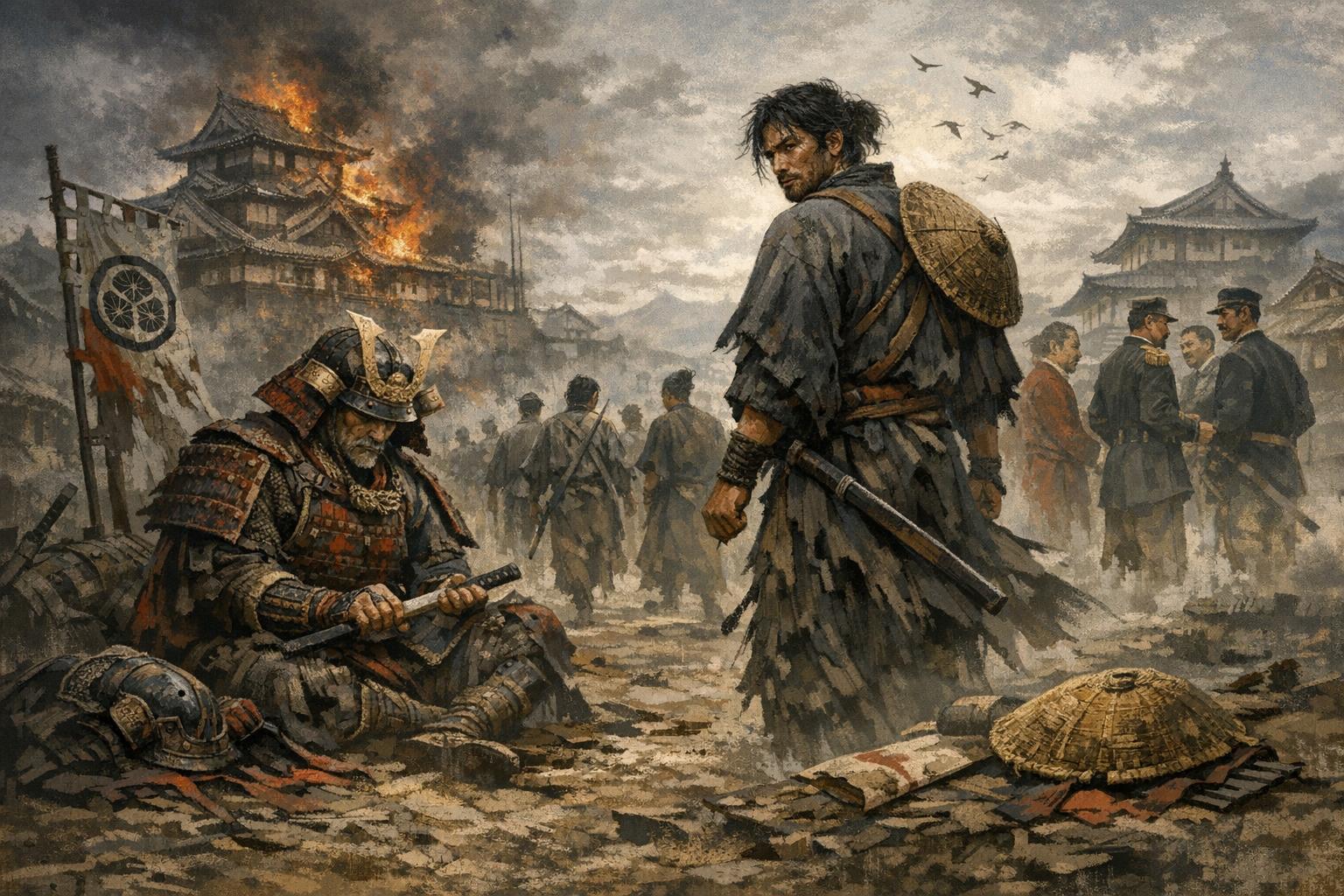
The Decline of the Samurai Class
The decline of the samurai class was a gradual and multifaceted process that took shape over several centuries in Japan. While the formal dismantling of samurai privilege occurred during the late nineteenth century, the forces that weakened their social and political dominance had been developing long before the Meiji Restoration. The samurai were not solely warriors; they were administrators, land stewards, and cultural figures who played a central role in shaping feudal Japan. Their transformation and eventual loss of status reflected deeper structural changes in Japanese society, including economic development, political centralization, and the adoption of Western institutions.
From their emergence as a distinct warrior elite in the late Heian period to their dominance under the Tokugawa shogunate, the samurai occupied a privileged and legally defined position within a rigid social hierarchy. They enjoyed stipends, legal rights to bear arms, and authority over commoners. By the nineteenth century, however, the foundations supporting that status had eroded. Economic stagnation, fiscal strain on feudal domains, changing patterns of warfare, and growing external pressures converged to dismantle a class that had once defined Japanese governance and military organization.
Economic Challenges
Economic change was one of the principal forces behind the decline of the samurai. During the Tokugawa period (1603–1868), Japan experienced prolonged internal peace. While stability allowed agricultural production and local commerce to expand, it also reduced opportunities for military distinction and reward. Samurai, who had once been compensated through land grants or rights to collect taxes, were increasingly converted into salaried retainers. Their income typically came in the form of fixed stipends measured in rice, which were calculated according to hereditary rank rather than economic productivity.
Over time, this system became problematic. Agricultural yields did not always increase in proportion to population growth, and fluctuations in rice prices introduced instability into domain finances. As commercial exchange intensified and urban markets expanded, wealth generation shifted toward trade, finance, and artisanal production. Merchants, officially placed near the bottom of the social hierarchy, accumulated substantial capital. By contrast, many samurai were legally restricted from engaging openly in commerce, limiting their ability to adapt to the changing economy.
Inflation further undermined the stipend system. Samurai incomes, fixed in nominal rice value, did not adjust easily to market conditions. As living costs rose, especially in urban centers such as Edo, Osaka, and Kyoto, numerous lower-ranking samurai faced chronic debt. Some borrowed from merchant houses, deepening their dependency on a class that official ideology considered inferior. Others took on secondary occupations, such as teaching or calligraphy, sometimes in tension with social expectations. Financial strain weakened both the autonomy of individual samurai and the fiscal stability of the domains that supported them.
Domain governments themselves encountered mounting debt. Maintaining hereditary stipends for a large warrior population imposed substantial financial burdens at a time when tax extraction from peasants could not be increased indefinitely. Reform efforts in the eighteenth and nineteenth centuries attempted to curb expenditures, promote frugality, and encourage new revenue sources, yet these measures yielded uneven results. The cumulative effect was a system in which many samurai were economically marginalized even before their formal abolition.
Changes in Military Needs
The transformation of warfare played a critical role in diminishing the traditional function of the samurai. During the tumultuous Sengoku period (fifteenth to sixteenth centuries), military skill determined political survival. Samurai leadership in cavalry tactics, archery, and swordsmanship formed the backbone of regional power. However, the introduction of firearms in the mid-sixteenth century altered battlefield dynamics. Mass infantry units equipped with arquebuses reduced the exclusive advantage previously held by mounted warriors.
Although samurai adapted to these innovations, including organizing and commanding firearm units, the growing importance of disciplined formations and logistical coordination shifted attention away from individual martial prowess. By the early seventeenth century, the Tokugawa shogunate consolidated political authority and imposed a long era of peace. Large-scale conflict became rare, and the need for constant battlefield readiness diminished substantially.
In the absence of warfare, the samurai’s role evolved into one centered on administration and governance. They served as bureaucrats, tax officials, scholars, and regional overseers. This shift required literacy, familiarity with Confucian ethics, and competence in record-keeping. The martial identity that had once defined the class gradually blended with civil responsibilities. Swordsmanship and martial training were preserved symbolically and culturally, but their practical necessity declined.
As the nineteenth century progressed, exposure to Western military techniques underscored further limitations of the hereditary warrior model. Modern armies in Europe and the United States were organized through conscription, standardized training, and advanced weaponry. Their effectiveness did not depend on a restricted hereditary elite. Japanese reformers observed these developments and concluded that the maintenance of a separate warrior class hindered national defense modernization. The very characteristics that had once defined samurai superiority—exclusive right to bear arms and hereditary rank—appeared increasingly incompatible with new military realities.
Political Centralization and Structural Reform
Political factors were equally significant in accelerating the decline of the samurai class. Under the Tokugawa system, Japan was divided into domains (han) governed by daimyo who pledged allegiance to the shogun. Samurai were attached to these domains and owed loyalty to their lords. While this structure enabled decentralized administration, it also entrenched regional autonomy and hereditary privilege.
By the mid-nineteenth century, external pressures intensified calls for reform. Western powers, armed with superior naval technology, demanded trade agreements. The arrival of Commodore Perry in 1853 exposed Japan’s vulnerability. Internal critics argued that the fragmented political order and outdated military organization limited effective national response.
The collapse of the Tokugawa shogunate in 1868 and the restoration of formal imperial authority under the Meiji government marked a decisive turning point. Reform leaders sought to centralize power and construct a unified nation-state. In 1871, the domain system was abolished and replaced with prefectures under central administration. This abolition of the han directly undermined the institutional basis of samurai authority, as their position had been defined by service to domain lords.
Subsequent reforms eliminated hereditary stipends. Initially, the government commuted stipends into government bonds, but this measure effectively ended guaranteed incomes. The right of samurai to carry swords in public was revoked in the Haitōrei Edict of 1876. These policies symbolized and enforced the legal equality of former samurai with commoners, redefining them as part of a unified citizenry rather than a privileged caste.
The Meiji Restoration
The Meiji Restoration was not solely an institutional restructuring; it was a broad program of modernization. Leaders aimed to transform Japan into a competitive industrial and military power capable of resisting colonial domination. This objective required administrative efficiency, fiscal reform, and the mobilization of national resources.
A central component of this transformation was the creation of a modern conscript army in 1873. The new military drew recruits from the general male population, regardless of former social status. By replacing the hereditary warrior class with a national force, the government aligned itself with contemporary European models. Training, discipline, and technology superseded lineage as the basis for military capability.
For many samurai, these measures represented both material loss and an identity crisis. While some entered the new army as officers or took bureaucratic positions in government ministries, others struggled to find comparable roles. A number of uprisings occurred, most notably the Satsuma Rebellion of 1877, led by Saigō Takamori. The rebellion was ultimately suppressed by the conscript army, demonstrating the effectiveness of the reformed system and confirming the end of samurai military dominance.
The Rise of the Ronin
Even before the Meiji Restoration, the phenomenon of the ronin—a masterless samurai—reflected structural instability within the class. A ronin typically emerged when a lord died without an heir, was dispossessed, or reduced his retainer ranks for financial reasons. In a society where loyalty and defined service relationships were central to social organization, the absence of a lord placed a samurai in a precarious position.
Some ronin succeeded in securing service under new patrons or transitioning into teaching, scholarship, or domain administration. Others encountered economic hardship and social ambiguity. The presence of ronin indicated that the hereditary system was not entirely stable even during the Tokugawa period of relative peace.
Following the abolition of domains, the number of former samurai without traditional roles increased significantly. While they were no longer classified formally as ronin in the feudal sense, many experienced similar uncertainty. The transition from hereditary warrior to ordinary citizen required adjustment to a society in which legal distinctions between classes were formally removed. The broader cultural memory of the ronin later came to symbolize adaptation to structural change rather than simply dispossession.
Legacy of the Samurai and Ronin
Although the samurai class declined as a distinct legal category, its cultural and intellectual legacy persisted. Educational reforms in the Meiji period benefited from high literacy rates among former samurai, allowing many to become teachers, civil servants, or contributors to emerging institutions. Values associated with discipline, loyalty, and self-cultivation were incorporated into modern state ideology and corporate culture, albeit in new forms.
The moral code often associated retrospectively with the samurai, commonly referred to as bushidō, was reshaped during the modern era. While earlier samurai ethics had varied across regions and periods, late nineteenth- and early twentieth-century thinkers systematized and reinterpreted these traditions to support national unity and civic responsibility. In this way, elements of samurai identity were adapted to serve a modern state rather than a feudal order.
Cultural representations in literature, theater, and later film reinforced the enduring image of the samurai and ronin. These portrayals frequently emphasized themes of duty and moral choice within changing social conditions. Such representations contributed to both domestic and international understandings of Japanese history, sometimes simplifying complex historical processes while preserving interest in the period.
In structural terms, the decline of the samurai represented the replacement of a hereditary status hierarchy with a centralized nation-state organized around citizenship and merit-based advancement. The transformation illustrates how economic modernization, political consolidation, and technological innovation can alter long-standing social institutions. The samurai were not simply displaced; many participated actively in building the new order, transferring administrative skills and educational advantages into modern professions.
The decline of the samurai class therefore cannot be understood as a single event but as a convergence of gradual economic strain, evolving military organization, political reform, and international influence. By the early twentieth century, the legal category of samurai had disappeared, yet its historical significance remained embedded in Japan’s institutional development and cultural memory. The trajectory from feudal retainer to modern citizen provides a case study in how established elites adapt—or fail to adapt—to systemic transformation.