
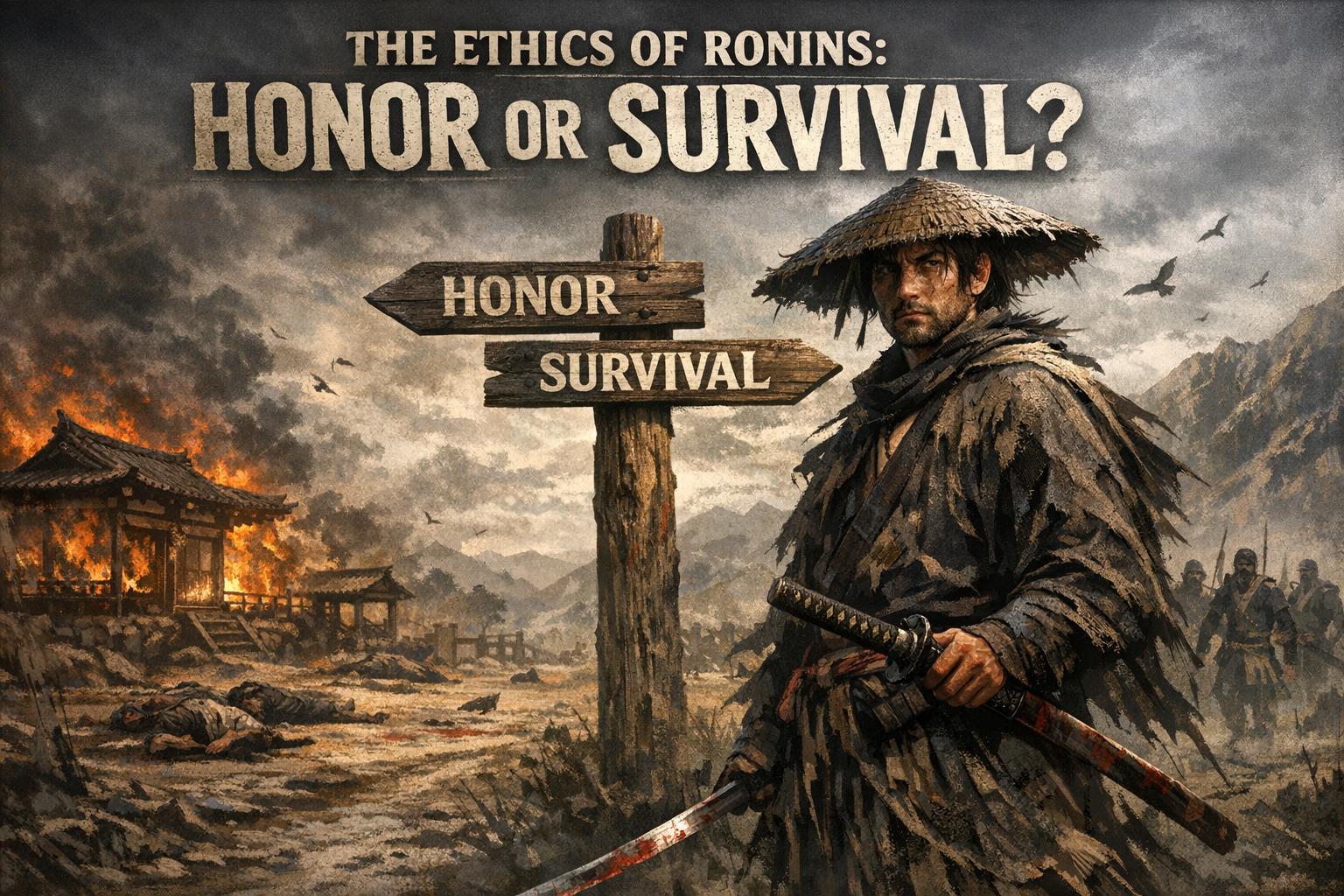
The Concept of Ronin
The term ronin designates a samurai who no longer served a lord during Japan’s feudal era. Literally meaning “wave man,” the word evoked the image of a person adrift, moving without stable attachment. During the Edo period (1603–1868), when political authority consolidated under the Tokugawa shogunate, the status of a ronin became especially visible. Social order was rigidly structured, and samurai were expected to exist within clearly defined hierarchies of loyalty and service. When a lord died, was defeated, or confiscated lands were reassigned, retainers could find themselves without employment and social identity.
The condition of being masterless was not merely administrative. It carried legal, social, and ethical consequences. Samurai privilege derived from service; without it, their stipends ceased, and their rank lost practical support. A ronin might retain the right to wear swords, yet without income and affiliation, this status often became symbolic. The ronin’s existence therefore unsettled established categories. They remained samurai in training and ethos, yet no longer occupied the institutional position that gave samurai life coherence. This ambiguity created enduring debates concerning the balance between honor and survival.
Historical Context
To understand the ronin, it is necessary to consider the structure of feudal Japanese society. The Tokugawa shogunate organized society into a status hierarchy composed of warriors, farmers, artisans, and merchants. At the top of this order stood the samurai class, whose identity centered on martial service and loyalty to a daimyo, or regional lord. Samurai received stipends, often paid in rice, in exchange for administrative and military duties. Their lives were regulated by both law and cultural expectations, with bushido providing the ethical vocabulary that justified their role.
Bushido, often translated as “the way of the warrior,” was not a single codified document but a collection of ideals articulated through texts, conduct manuals, and philosophical commentary. It emphasized loyalty, filial piety, courage, sincerity, and a willingness to place duty above personal interest. Within this framework, service to one’s lord was a central moral obligation. A retainer’s identity was fused with that of the household he served.
Political stability during much of the Edo period reduced large-scale warfare, but it did not eliminate instability among domains. When a daimyo died without an heir, committed an offense, or lost favor with the shogunate, his domain might be abolished. Retainers suddenly found themselves unemployed. In earlier centuries, such dislocation might have been temporary as warfare created new openings. Under Tokugawa rule, opportunities were fewer. The peace that defined the era also restricted mobility.
In this context, some samurai chose seppuku, ritual suicide, particularly if their lord had died dishonorably or if they felt responsible for failure. This act was considered a means of preserving personal and familial honor. Yet many did not take this path. Their transformation into ronin reflected differing interpretations of duty, practical constraints, or hope for future employment. Over time, the presence of significant numbers of ronin became a social concern for authorities, who feared unemployment could translate into unrest.
The Ethics of Honor
Within the ideology of samurai conduct, honor functioned as both individual virtue and social expectation. An honorable warrior demonstrated fidelity to his lord and consistency between word and action. If loyalty defined a samurai’s moral horizon, the loss of a lord raised a critical question: What course of action best preserved integrity?
Some interpretations of bushido suggest that death was preferable to living without purpose. Surviving the destruction or disgrace of one’s lord might be construed as evidence of insufficient loyalty. Committing seppuku could express protest, atonement, or solidarity. In certain cases, families and domain officials expected retainers to follow their lord in death, reinforcing communal standards of devotion.
However, ethical practice was not purely abstract. Samurai were embedded in households with dependents. A decision for ritual suicide affected wives, children, and extended kin. If the concept of honor prioritized self-sacrifice to the point of destabilizing the family line, tensions emerged between competing duties. Confucian influences in Edo thought emphasized filial responsibility and continuity. Maintaining lineage could also constitute a moral imperative.
Moreover, the portrayal of honor as absolute sometimes obscures its political function. The expectation that retainers die for defeated lords could reinforce hierarchical power. By valorizing self-sacrifice, ruling authorities sustained a culture where subordinates internalized obedience. From this perspective, the insistence on death over survival might serve structural stability more than individual ethical flourishing.
This interpretation does not invalidate the sincerity with which many samurai embraced these ideals. Rather, it highlights that ethical systems operate within social frameworks. For some individuals, choosing life as a ronin did not necessarily represent abandonment of honor but rather a reinterpretation of what honor required under changed circumstances.
Survival as a Necessity
The decision to remain alive after losing a lord can also be examined through the lens of pragmatic necessity. Without stipends, ronin frequently faced financial hardship. Some sought new employment with other lords; others became instructors in martial arts, consultative strategists, scholars, or administrators. A number entered commercial ventures, despite formal prohibitions against samurai engagement in trade. A minority engaged in criminal activity, contributing to negative stereotypes.
Adaptation required flexibility. In a society that emphasized heredity and status continuity, reinventing oneself was not straightforward. Yet evidence shows that many ronin integrated into alternative occupations. Some became teachers of Confucianism or calligraphy. Others entered urban bureaucracies as the commercial economy expanded during the Edo period. Through these transitions, they demonstrated that survival could align with maintaining aspects of samurai identity such as discipline and education.
The ethical dimension of survival lies in recognizing human life as a value not automatically subordinate to symbolic duty. For a retainer whose lord had died due to illness or political sanction beyond his control, self-destruction might not advance any tangible good. Continuing to live allowed for service in different forms, whether to family, community, or new employers. In this respect, survival can be interpreted as responsibility rather than evasion.
The shogunate itself adopted ambivalent policies toward ronin. While wary of unrest, authorities sometimes facilitated their placement or restricted their movement to maintain order. The presence of ronin was therefore managed rather than universally condemned. This practical governance approach suggests that survival outside direct lordship became an administratively acknowledged reality.
An important case frequently referenced is that of the Forty-Seven Ronin in the early eighteenth century. After their lord was compelled to commit seppuku, they became masterless. Rather than ending their lives immediately, they planned and executed retaliation against the official they believed responsible. Following this act, they themselves were ordered to commit seppuku. Interpretations of this episode vary, but it illustrates that the category of ronin could encompass complex negotiations between delayed loyalty and tactical survival.
Modern Interpretations
In modern scholarship and cultural production, the ronin occupies a multifaceted symbolic position. Literature, theater, and film have repeatedly returned to the image of the masterless warrior. Sometimes ronin are portrayed as marginal figures navigating rigid hierarchies; in other instances, they appear as independent actors unbound by institutional constraints. These narratives often explore questions of agency, identity, and legitimacy.
From a historical perspective, contemporary analysis tends to contextualize rather than romanticize. Researchers examine archival documents to reconstruct everyday experiences of ronin households, including financial records and legal petitions. Such evidence complicates simplified images of either noble defiance or social deviance. It reveals variability in outcomes, ranging from integration into stable roles to chronic instability.
Philosophically, the ronin can be situated within broader discussions about the relationship between societal expectation and personal conviction. The tension between dying for principle and adapting to survive is not unique to feudal Japan. Comparable dilemmas arise in many historical contexts where institutional loyalty conflicts with individual welfare. The ronin thus becomes an analytical lens for examining how moral systems respond to disruption.
Modern interpretations sometimes associate ronin with notions of individual autonomy. Detached from formal allegiance, they represent the possibility of redefining one’s path. Yet historical evidence indicates that such autonomy was limited by economic and legal constraints. Recognizing these limits prevents projecting contemporary values backward without qualification.
At the same time, the debate over honor and survival continues to resonate because it addresses enduring ethical concerns. Should adherence to collective codes supersede personal continuation? Does survival imply compromise, or can it reflect resilience? The lives of ronin demonstrate that ethical reasoning often takes place under pressure, where options are constrained and consequences extend beyond the individual.
The enduring relevance of the ronin concept lies in its exposure of the fragility of identity constructed solely through institutional affiliation. When service to a lord ended, the samurai confronted a void in defined purpose. Responses varied, shaped by material conditions, philosophical influences, and personal conviction. Some embraced death as affirmation of loyalty. Others chose continuation, seeking reemployment or alternative vocations. Neither path can be reduced to a simple hierarchy of virtue.
In examining the ronin, it becomes clear that honor and survival were not mutually exclusive categories but interacting considerations. Honor could motivate delayed action rather than immediate self-destruction. Survival could enable ongoing responsibility rather than self-interest alone. The interplay between these principles reflects a broader human negotiation between ideals and circumstances.
Understanding this balance contributes to discussions beyond the specific historical setting. It invites reflection on how ethical codes are interpreted in periods of stability versus disruption, and how individuals navigate the disjunction between prescribed roles and lived reality. The ronin, situated at the margin of a rigid hierarchy, illuminate how societies define legitimacy and how individuals respond when that legitimacy is withdrawn.
By examining the ronin within their historical framework and through modern analysis, one perceives a nuanced portrait. The masterless samurai were neither uniformly disgraced nor inherently heroic. They occupied a variable social position shaped by policies, economic shifts, and moral discourse. Exploring their experience clarifies the complexities embedded within concepts often treated as absolute. Through this lens, the tension between duty and endurance appears not as a binary opposition but as an ongoing ethical negotiation embedded in specific historical circumstances.